
N/A
0,375
2001
Domaine Lejeune

Pommard Les Poutures Premier Cru 2001 0,375L
€ 54,00 in.VAT
Wines, producers, regions...
Côte d'Or
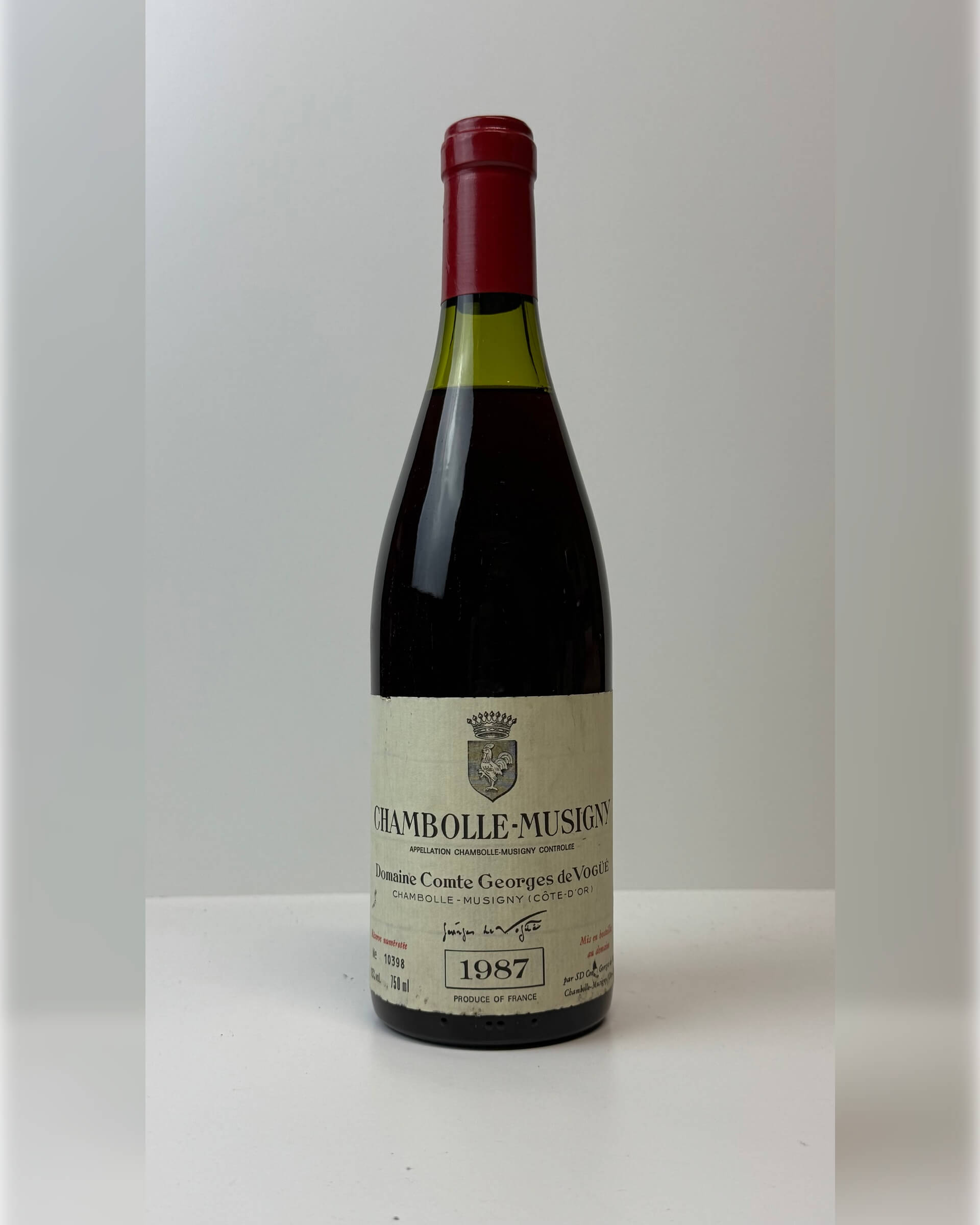
Domaine Comte Georges de Vogue
1 in stock
ROBERT PARKER " In 1987, the Chambolle-Musigny is light, lacking a bit in concentration and character, but straightforward and fruity. If someone like Christophe Roumier was making this wine, I think it could be even better. I have to believe that more extract, complexity, and character could be obtained if it was so desired. The 1987 is good, but it probably could have been thrilling. "
Domaine Comte Georges de Vogüé stands among Burgundy’s aristocracy, with a heritage stretching back to 1450 when Jean Moisson first acquired vineyards in Chambolle-Musigny. The domaine takes its current name from Comte Georges de Vogüé, who inherited the estate in 1925 and rebuilt its reputation following phylloxera devastation and World War I disruptions. Today, the domaine encompasses 12.5 hectares, including an astonishing 7.2 hectares of Musigny Grand Cru (the largest holding in this legendary vineyard) and 2.75 hectares of Bonnes-Mares Grand Cru—a concentration of premier terroir unmatched by any other producer.
The estate’s modern era of excellence began in 1986 when François Millet assumed winemaking responsibilities, implementing stricter vineyard management and more rigorous selection standards. The controversial decision to declassify the estate’s Musigny production from 1972-1992 (relegating it to village Chambolle or selling it off) demonstrated unwavering commitment to quality over commercial considerations—a bold move that cemented Vogüé’s reputation for uncompromising standards. Under Millet’s guidance, and continuing with current winemaker Jean-Luc Pépin, Domaine de Vogüé has produced wines of extraordinary purity, elegance, and aging potential.
The domaine’s village Chambolle-Musigny bottling, while less celebrated than its Grand Cru offerings, embodies the essence of Chambolle terroir with remarkable fidelity. Sourced from parcels throughout the appellation (including fruit from younger vines in Grand Cru sites), the wine receives the same meticulous attention as the domaine’s most prestigious cuvées: hand-harvesting, rigorous sorting, whole-cluster fermentation, gentle extraction, and aging in French oak (typically 25-35% new wood). The result is a wine that captures Chambolle’s signature characteristics—perfume, elegance, silky texture—while offering exceptional value relative to the domaine’s Grand Cru bottlings.
Chambolle-Musigny occupies a privileged position in the Côte de Nuits, nestled between Morey-Saint-Denis to the north and Vougeot to the south. The village’s vineyards climb steep slopes above the village, with exposures ranging from east to southeast that capture gentle morning sun while avoiding excessive afternoon heat. This unique microclimate, combined with the appellation’s distinctive soils, produces Pinot Noir of unparalleled refinement and aromatic intensity.
The geological foundation of Chambolle is primarily Bajocian limestone overlaid with thin topsoils rich in marl and clay. The limestone provides excellent drainage and imparts the mineral backbone that supports the wine’s structure, while the marl contributes to the silky, fine-grained tannins that define Chambolle’s texture. The slopes’ elevation and gradient create natural water stress during summer, concentrating flavors while preserving acidity—essential for wines intended for long aging.
Chambolle-Musigny is often described as Burgundy’s most ‘feminine’ appellation, a somewhat dated but persistent characterization that attempts to capture the wine’s distinctive delicacy, perfume, and grace. Where Gevrey-Chambertin delivers power and structure, and Vosne-Romanée offers opulence and richness, Chambolle provides elegance and subtlety—wines that seduce through finesse rather than force. The appellation’s greatest sites (Musigny, Les Amoureuses, Les Charmes) exemplify these qualities at the highest level, but even village-level Chambolle from quality producers like Vogüé displays this characteristic refinement.
Domaine de Vogüé’s village parcels are scattered throughout Chambolle, benefiting from diverse exposures and soil compositions that add complexity to the final blend. The 1987 vintage would have been vinified using traditional Burgundian methods: whole-cluster fermentation (partial or complete), fermentation in open wooden vats, manual pigeage (punch-downs), and aging in French oak barrels for 12-18 months before bottling. The relatively cool 1987 vintage would have produced wines of moderate alcohol, bright acidity, and elegant structure—ideal characteristics for extended aging.
The 1987 vintage in Burgundy was challenging and ultimately overshadowed by the exceptional 1985 and highly regarded 1988 that bookended it. The growing season began with a difficult spring featuring late frosts and cool temperatures that disrupted flowering, reducing potential yields. Summer brought variable weather with periods of rain interspersed with warm, sunny days—conditions that demanded careful canopy management and green harvesting to ensure ripeness and concentration.
Harvest occurred in late September under uncertain conditions, with producers forced to make critical decisions about picking dates. Those who waited for optimal phenolic maturity (as quality estates like Vogüé invariably did) harvested grapes with moderate sugar levels, bright acidity, and thin but elegant skins—characteristics that translated into wines of finesse rather than power. The 1987s were not blockbuster vintages; they lacked the concentration and structure of great years, leading to initial critical dismissal and modest commercial success.
However, time has been kind to well-made 1987 Burgundies, particularly those from top estates with old vines and exceptional terroir. The vintage’s moderate alcohol, high acidity, and elegant structure have proven ideal for extended aging, with wines developing complex tertiary characteristics—forest floor, truffle, leather, dried flowers—while retaining remarkable freshness. At 37 years of age, 1987 Chambolle-Musigny from Domaine de Vogüé has reached full maturity, offering the haunting, ethereal qualities that only time can bestow on great Burgundy.
The vintage’s initially modest reputation means that fewer bottles were cellared long-term, making well-preserved examples increasingly rare. Collectors seeking mature Burgundy often overlook 1987 in favor of ‘safer’ vintages like 1985 or 1990, creating opportunities for those willing to explore beyond conventional vintage hierarchies. For wines from impeccable provenance and prestigious producers like Vogüé, 1987 offers exceptional value relative to more celebrated years, delivering mature complexity at more accessible price points.
Mature Burgundy of this age demands careful handling to maximize enjoyment. Store the bottle upright for 24-48 hours before opening to allow any sediment to settle to the bottom. Open the bottle 1-2 hours before serving to allow initial volatile compounds to dissipate, but avoid excessive aeration—mature wines are fragile and can fade quickly with too much oxygen exposure. Decant carefully and gently, stopping when sediment reaches the neck of the bottle. Use a candle or light beneath the bottle neck to monitor sediment during decanting. Pour into large Burgundy glasses (Zalto Burgundy, Riedel Sommeliers Burgundy Grand Cru) at 14-16°C—slightly cooler than room temperature to preserve the wine’s delicate aromatic profile. The wine will evolve in the glass over 60-90 minutes, revealing different facets as it opens, so patience is essential. Serve in a quiet, contemplative setting where the wine’s subtlety can be appreciated without distraction. Given the wine’s age and value, consider sharing it with knowledgeable wine enthusiasts who will appreciate its rarity and character. Once opened, the wine should be consumed within 3-4 hours; mature Burgundy does not benefit from extended exposure to air and will eventually fade. This is a wine for special occasions, milestones, or moments of reflection—a liquid connection to 1987 and the generations of vignerons who have shaped Burgundy’s legacy.
Exceptional pairings:
At 37 years of age, Domaine de Vogüé Chambolle-Musigny 1987 has reached full maturity and should be consumed within the next 3-5 years. While the wine remains in excellent condition (assuming proper storage throughout its life), further aging offers diminishing returns—the wine has revealed all its secrets and will gradually fade rather than improve. Store upright in a temperature-controlled cellar at 12-14°C with 70% humidity, away from light and vibration. If you possess multiple bottles, consider opening one soon to assess current condition, then spacing subsequent bottles over the next few years to observe the wine’s evolution in its final chapter. For collectors, this bottle represents both a drinking opportunity and a piece of Burgundian history—the decision to drink or hold becomes a personal choice between experiencing the wine at its peak versus preserving it as a collectible artifact. The Vogüé name and the wine’s age ensure continued collectibility, though drinking windows for wines of this maturity are finite. Provenance is critical for wines of this age—verify storage history when possible, and inspect the fill level (mid-shoulder or higher is acceptable; below mid-shoulder suggests potential spoilage risk). This is a wine that has survived nearly four decades to deliver its message; honor that journey by opening it thoughtfully and sharing it with those who will appreciate its significance.
You May Also Like

€ 480,00 in.VAT
This site is restricted to adults. By entering, you confirm that you are of legal drinking age in your country of residence.
Reviews
There are no reviews yet.