When we think of investments, we typically imagine stock tickers, real estate portfolios, or perhaps gold bars. However, for the connoisseur with a sharp eye for value, the most enjoyable assets are often found in a cellar, not a bank vault.
Investing in fine wine has evolved from a hobby for the aristocracy into a robust, high-performing asset class. Over the last two decades, fine wine has frequently outperformed the S&P 500 and gold, offering lower volatility and tangible ownership. But unlike stocks, you cannot simply buy a random bottle and expect it to appreciate.
At TourDeWine, we specialize in the rare, the exquisite, and the investment-grade. Whether you are looking to secure a bottle of Château Pétrus or a rare vintage from Domaine Leroy, this guide will introduce you to the art of liquid assets.
Why Invest in French Wine?
The economic principle behind wine investment is beautifully simple: decreasing supply meets increasing demand.
When a top estate in Bordeaux or Burgundy releases a vintage, the supply is fixed. As bottles are consumed worldwide, the remaining quantity decreases. If the wine is of high quality and critical acclaim, the rarity drives the price upward over time.
1. Stability in Turbulent Markets
Fine wine has little correlation with the stock market. During economic downturns, collectors rarely liquidate their cellars, keeping prices stable. It is a “defensive asset” that preserves wealth.
2. Tangible Ownership
You own a physical product. In the worst-case scenario (which is hardly a tragedy), if the investment doesn’t perform as expected, you are left with a world-class wine to enjoy with friends and family.
The Two Pillars of Profit: Bordeaux and Burgundy
While the Rhone Valley, Champagne, and Italy offer excellent opportunities, the “blue chips” of the wine investment world remain firmly rooted in France.
Bordeaux: The Blue-Chip Stock
Bordeaux is the backbone of any wine portfolio. The market here is driven by the famous 1855 Classification.
- Key Names: You should focus on the “First Growths” (Premiers Crus) such as Château Margaux, Château Latour, Château Lafite Rothschild, Château Mouton Rothschild, and Château Haut-Brion.
- Right Bank Legends: Never overlook the Right Bank, specifically Pomerol. Here reigns Château Pétrus—one of the most sought-after wines on the planet. Its limited production ensures constant demand.
Burgundy: The High-Risk, High-Reward Gem
If Bordeaux is the “blue-chip stock,” Burgundy is the “unicorn startup.” Production quantities are microscopic compared to Bordeaux, making scarcity the primary driver.
- The King and Queen: The most coveted bottles come from Domaine de la Romanée-Conti (DRC) and Domaine Leroy.
- Why Leroy? Under the guidance of Madame Lalou Bize-Leroy, these biodynamic wines have seen astronomical price increases in recent years. Finding a bottle of Domaine Leroy Musigny or Chambertin is a quest in itself—one that we at TourDeWine are proud to facilitate for our clients.
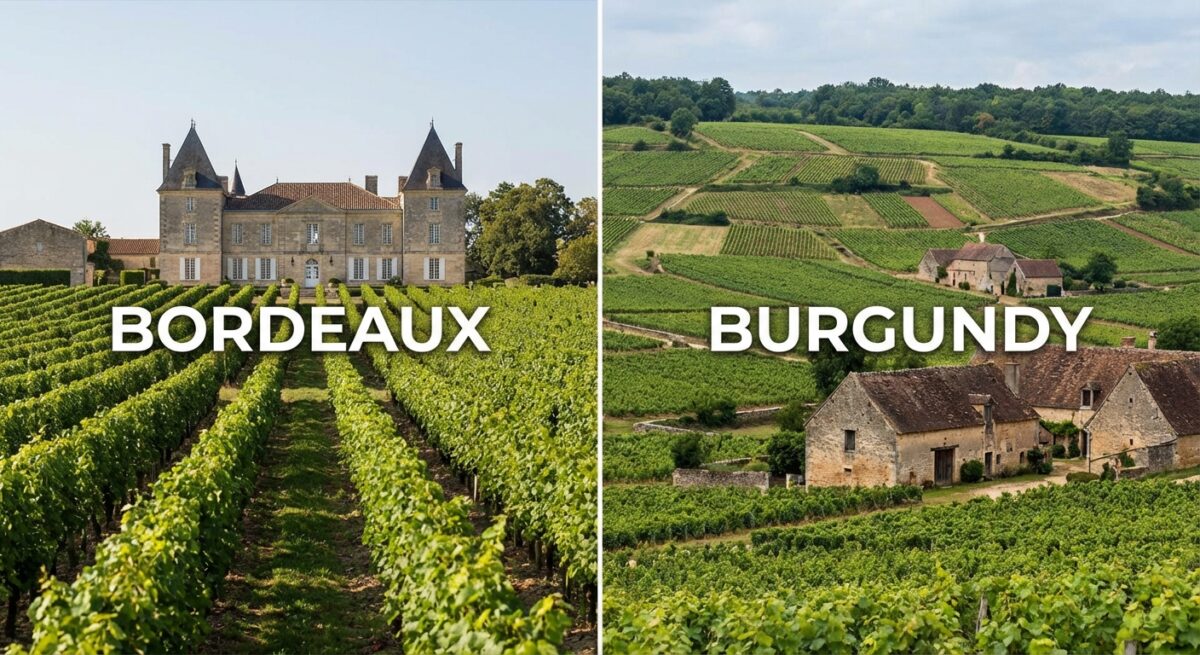
![Image Suggestion: A map of French wine regions or a split image showing a Bordeaux Chateau vs. a Burgundy vineyard. Alt text: Bordeaux and Burgundy vineyards.]
How to Spot an “Investable” Bottle
Not every “Grand Cru” is an investment. To maximize your ROI (Return on Investment), you must look for the “Perfect Storm” of three factors:
1. The Vintage (The Year)
In France, weather dictates quality. A “great vintage” produces wines that can age for 30, 40, or 50 years.
- Legendary Years to Buy Now: Look for 2005, 2009, 2010, 2015, and 2016.
- The “Birthday” Strategy: Wines from specific years make incredible gifts, but for pure investment, stick to the critics’ favorites.
2. Critics’ Scores
The wine market moves on the words of critics like Robert Parker (Wine Advocate), James Suckling, or Neal Martin. A score of 95–100 points acts as a guarantee of quality for future buyers. A 100-point bottle is almost certain to appreciate in value.
3. Provenance (History)
This is the most critical factor. A bottle of 1982 Château Lafite is worthless if it was stored next to a radiator for 20 years.
Provenance refers to the bottle’s lifecycle. Investors only buy wines with a clear paper trail proving they have been stored in professional, temperature-controlled conditions.
Expert Note: At TourDeWine, every bottle in our online boutique is sourced with impeccable provenance. We guarantee the condition of our rare vintages, ensuring your investment is secure from day one.
Storing Your Liquid Gold
You cannot store investment wines in a standard kitchen fridge or on a living room rack. To mature properly and retain value, wine requires:
- Constant Temperature: Ideally 12°C – 14°C (53°F – 57°F).
- Humidity: Between 60% and 75% to keep the cork from drying out.
- Darkness: UV light destroys the delicate organic compounds in wine.
- Stillness: Vibration accelerates aging and disturbs the sediment.
If you do not have a professional cellar, consider using our storage services or purchasing professional wine cabinets. Remember: poor storage kills resale value.
How to Start Your Collection with TourDeWine
Building a portfolio doesn’t require millions of euros to start, but it does require expertise.
- Define Your Horizon: Are you investing for 5 years or 20 years?
- Diversify: A mix of Bordeaux (for stability) and Burgundy (for growth) is recommended.
- Buy the Best You Can Afford: It is better to buy one case of Petrus than ten cases of a mediocre wine.
Featured Investment Wines Available Now
We have curated a selection of wines that show strong potential for appreciation:
- Château Pétrus (Various Vintages): The ultimate asset for wealth preservation.
- Domaine Leroy: Extremely rare allocations for the serious collector.
- Rare Champagne: Vintage Champagne is currently the fastest-growing sector in the secondary market.
Conclusion
Investing in French wine is a journey of patience, passion, and prestige. It allows you to diversify your assets while engaging with a product steeped in history and culture.
Whether you are a seasoned investor looking to fill a gap in your cellar or a newcomer ready to make your first serious acquisition, TourDeWine is your partner in excellence.